
Hastings CBD
WestSide
Money, marble and the 1931 reset. The story of banking on Heretaunga Street West — from a sledge-delivered safe in December 1884 to the moment every bank on the street fell at once.
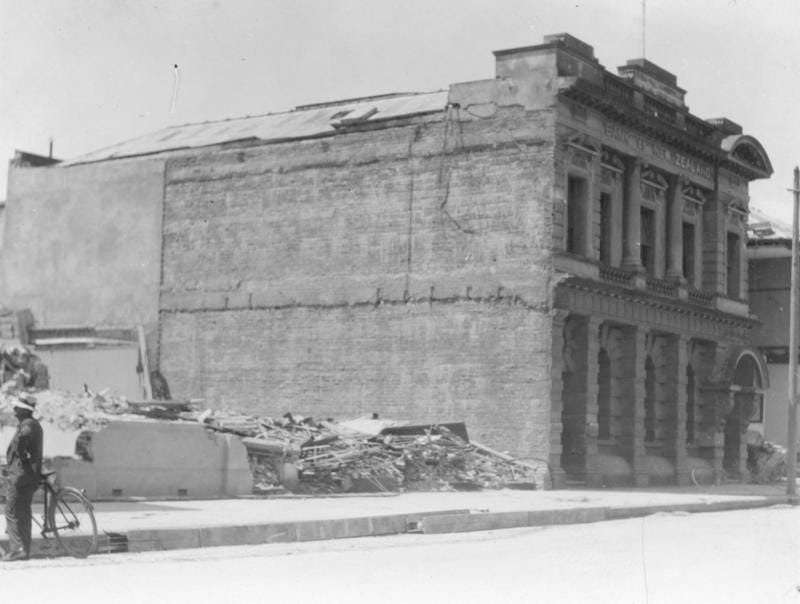 Bank of New Zealand · 117 Heretaunga Street West · Post 3 February 1931 · Frank Moodie Collection · MTG Hawke's Bay · Object 76651 · Gifted by Margaret Burton
In December 1884, two men sat down in a small building on Heretaunga Street West and waited for business to come along. The town had a population of about 600 or 700 people. The only way to get to Napier was by horse bus, coach or buggy. They had carried the bank's safe to the branch on a sledge with runners.
That was the Bank of New South Wales opening its Hastings branch... and waiting. The first customer to walk through the door was George Benjamin, local manager of the New Zealand Clothing Company. He came in to sign the bank's signature book. Somehow, business followed.
One hundred and forty years later, five banks still stand on WestSide. ANZ, ASB, SBS, Kiwibank and the others. They are here because their predecessors refused to leave. Three times the street burned or fell — in 1893, in 1907, and most catastrophically in 1931 — and three times the banks came back and built something better on the same ground.
That's the story of banking on WestSide. Not just where the money was kept... but who kept it there, what it cost them, and what it meant to a city that needed them to stay.
G.W. Harden was one of those two men. He'd been appointed as a junior at the Bank of New South Wales' new Hastings branch and he remembered the opening clearly, fifty years later, on a visit back to the town in January 1932. He was by then ex-manager of the Wanganui branch. The town he was visiting had just spent a year rebuilding from an earthquake. The branch he'd opened in 1884 had just been rebuilt for the third time.
"In those days, Hastings had a population of about 600 or 700 people, and the only way of travelling to Napier and Havelock was in horse 'buses and coaches, or in buggies. He and the late Mr Fred Parker, who was accountant in the Napier branch of the bank, opened the Hastings branch. There was little business for any banks to do, and his bank, as a newcomer, came here with many hopes but fewer expectations. The staff of two sat down and patiently waited for business to come along..."
The branch was established in a small building between what used to be Beck's Store and the site of the Bank of New Zealand. The safe and equipment were carried to the bank on a sledge with runners. It was not a grand opening.
But the Bank of New Zealand was already there. A court record from June 1885 confirms a cheque drawn on the Hastings branch of the Bank of New Zealand — meaning BNZ had established itself on Heretaunga Street West at least as early as 1885, and almost certainly before the Bank of New South Wales arrived.
By the late 1880s, the Union Bank of Australia had joined them. The National Bank of New Zealand. The Bank of Australasia. The Commercial Bank of Australia. Within a decade of Harden sitting down to wait for his first customer, WestSide had become the financial spine of Hawke's Bay — the place where the region's wool, grain, fruit and livestock earnings were banked, borrowed against, and lent back out into the plains.
WestSide burned in February 1893. The wooden buildings that lined Heretaunga Street West — the same construction that made them quick to build — made them easy to lose. The fire took the block. The banks rebuilt in brick and masonry. The street came back harder.
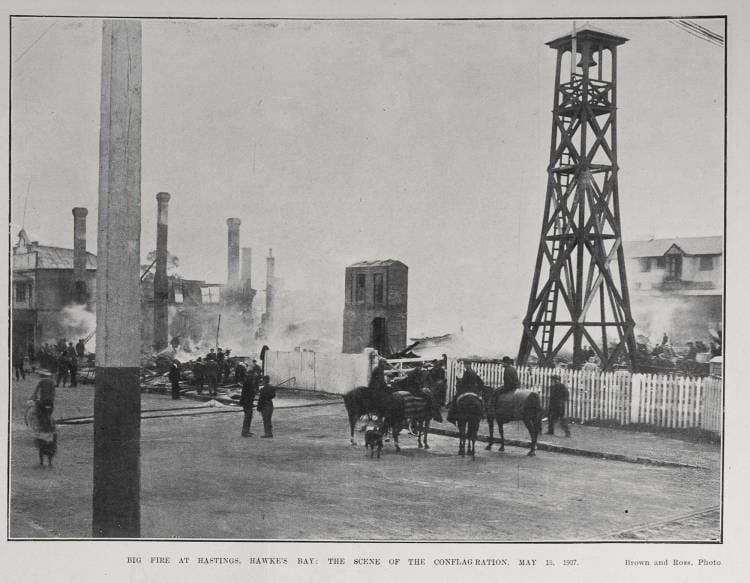 Hastings after the 1907 fire · Auckland Weekly News · 23 May 1907 · Auckland Libraries Heritage Collections AWNS-19070523-05-01 · Frank Moodie Collection
In May 1907 it happened again.
The Bank of New South Wales block — the one Harden had opened in 1884 — was destroyed along with every shop in the same block and the block across the street. Harden recalled it in 1932 as what locals called the big fire... the bank's branch, together with all the shops in the same block and across the street, were destroyed.
The bank rebuilt on the same site. Again. Same corner. New building. The branch that opened in a small timber structure beside Beck's Store in 1884 was now a proper banking chamber... solid, permanent-looking, announcing itself on the corner of Heretaunga Street West and Market Street as though it had always been there.
It had been there. That was the point. Forty-seven years of continuous operation on the same corner, through fires and floods and the slow transformation of a colonial town into a regional city. When the 1931 earthquake came, the Bank of New South Wales had been on that corner for longer than most of the people on the street had been alive.
Bank of New Zealand · 117 Heretaunga Street West · After the 1931 earthquake · Frank Moodie Collection · MTG Hawke's Bay Object 76651
The earthquake struck at 10:47am. Two and a half minutes. The ground heaved upward, paused for half a minute of deceptive calm, then came back down and shook. The noise was compared to an express train. Clouds of white dust rose from crumbled mortar and shattered concrete.
On the first block of Heretaunga Street West, the Bank of New Zealand at 117 Heretaunga Street West — a grand ornate Renaissance building built in 1907 after its predecessor was destroyed in that year's fire — survived the earthquake structurally but was badly damaged. On the corner of Market Street, the Bank of New South Wales — the oldest continuous business address on the strip — was the only bank building that did not fall. It was wooden. The irony is complete: the oldest bank, the one that had rebuilt twice already in brick and masonry, had retained enough of its original timber construction to flex rather than fracture.
The BNZ building survived the initial shock — its Renaissance brick and plaster construction held — but was badly damaged and had to be demolished. Every other bank on the street was destroyed or rendered uninhabitable. In the hours after the earthquake, while rescue workers pulled people from the rubble of Roach's Department Store and the Grand Hotel, the citizens of Hastings needed a place to coordinate. They chose the Bank of New South Wales corner. At 2pm on 3 February 1931, the meeting that would organise the city's recovery was held there. On the rubble. Beside the one bank that was still standing.
"While the work of rescue and fire fighting proceeded, a meeting of citizens was held at the Bank of New South Wales corner at 2 p.m., and a start was made with an organisation that through the succeeding weeks coordinated with the Mayor and Council and established a control that won praise for efficiency."
On 10 February 1931 — six days after the earthquake — the newspapers carried a formal notice signed by all six banks. The branches of the Bank of New Zealand, the National Bank of New Zealand, the Bank of New South Wales, the Union Bank of Australia, the Bank of Australasia, and the Commercial Bank of Australia had been closed from the time the earthquake occurred. The Government had authorised the postponement of banking until no later than Monday 16 February 1931... as soon as temporary premises could be provided.
Two days later, on 11 February, came the notice that landed harder. Every existing arrangement for advances between the banks and their customers in the Provincial District of Hawke's Bay was terminated. All of them. Farmers with seasonal credit lines. Businesses with overdraft facilities. Merchants who had borrowed against the next harvest. All terminated. Customers were invited to make proposals for future arrangements.
"Notice is hereby given that the branches of the undermentioned banks at Napier and Hastings have been closed as from the time the earthquake occurred on Tuesday, 3rd February, 1931... The Government has authorised the postponement of the resumption of banking business at the aforementioned towns until such date not later than Monday, 16th February, 1931, as it is practicable to provide banking facilities in temporary premises."
The six signatories were:
Bank of New Zealand — H. Buckleton, General Manager.
National Bank of New Zealand — J.T. Grose, General Manager.
Bank of New South Wales — R.C. Addison, Inspector.
Union Bank of Australia — W.A. Kiely, Inspector.
Bank of Australasia — W.L. Ward, Inspector.
Commercial Bank of Australia — E.P. Yaldwyn, Manager.
Six signatures. Six closed buildings. Six sets of records, ledgers, cash and securities somewhere in the rubble or the temporarily intact timber vault on the corner. And somewhere in the region, thousands of customers who had just been told that the credit arrangements that kept their farms and businesses running no longer existed.
The banks opened in temporary premises by 16 February 1931. Where exactly they operated during the months of rebuilding — whether in the same area, an area beyond the damaged buildings in hastily erected structures... is a question that more research is yet to answer. What is confirmed is that they came back.
All of them. In the Art Deco style. In new buildings on the same sites. The Bank of New South Wales — which had survived — decided that in keeping with other banking institutions having their premises rebuilt, the NSW branch should follow suit. The Australian owners chose to demolish the building that had just survived and build something new. Something that matched the street.
That building still stands on the corner of Heretaunga Street West and Market Street. It is the third building the Bank of New South Wales built on that site since 1884. It became Westpac. Westpac operates on EastSide, diagonally opposite ANZ on the corner of Heretaunga Street East and Market Street. But the building remained — a corner of Hastings that has held a bank for 140 years, through fires and earthquakes and mergers and the complete transformation of the global financial system.
"The promptness with which the town got on with the work of rebuilding is only typical of the courage and enterprise with which the people of Hastings have faced their many difficult problems since the earthquake."
G.W. Harden · Ex-Manager, Bank of New South Wales · Hawke's Bay Tribune · 28 January 1932
The six banks that closed on 3 February 1931 did not all survive as independent institutions. Over the following century, mergers, acquisitions and failures reshaped the New Zealand banking landscape. The names changed. But some of the money — and some of the buildings — stayed on WestSide.

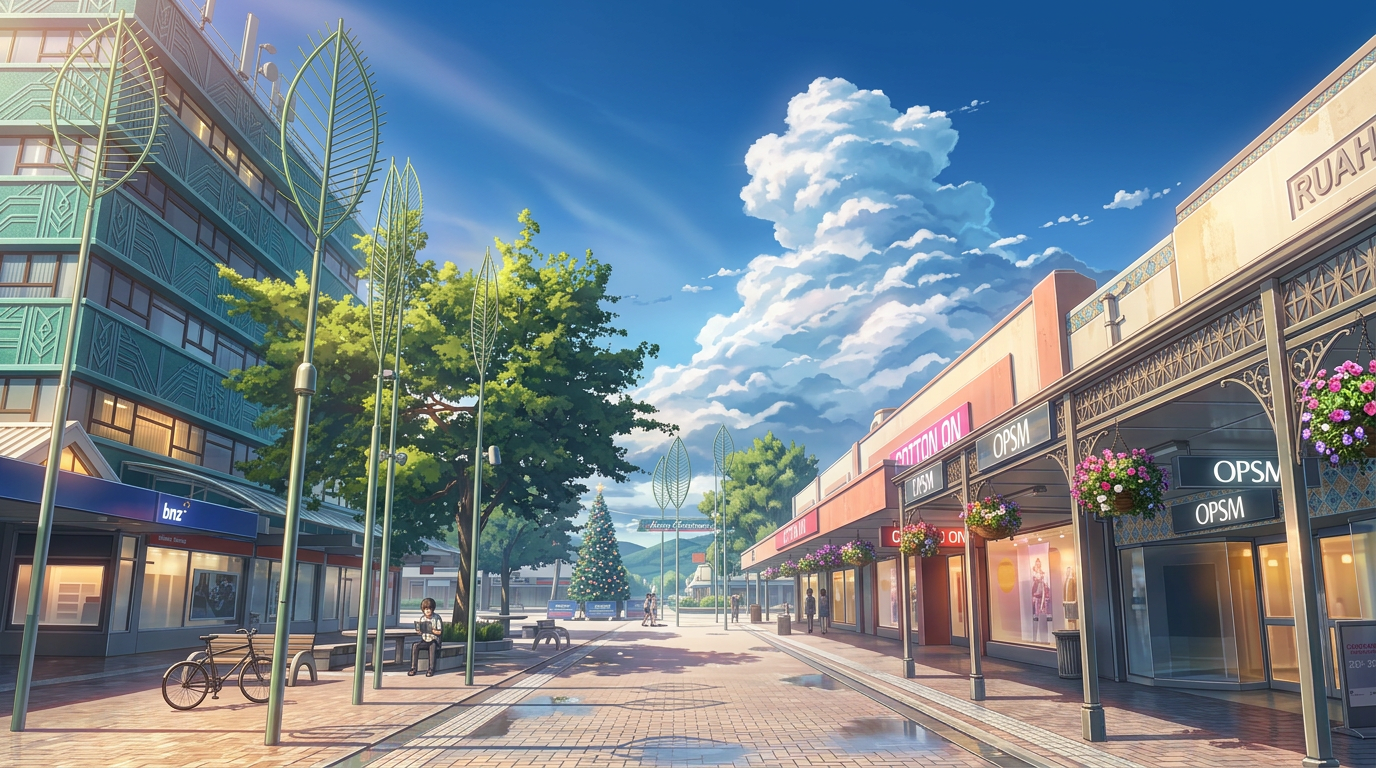
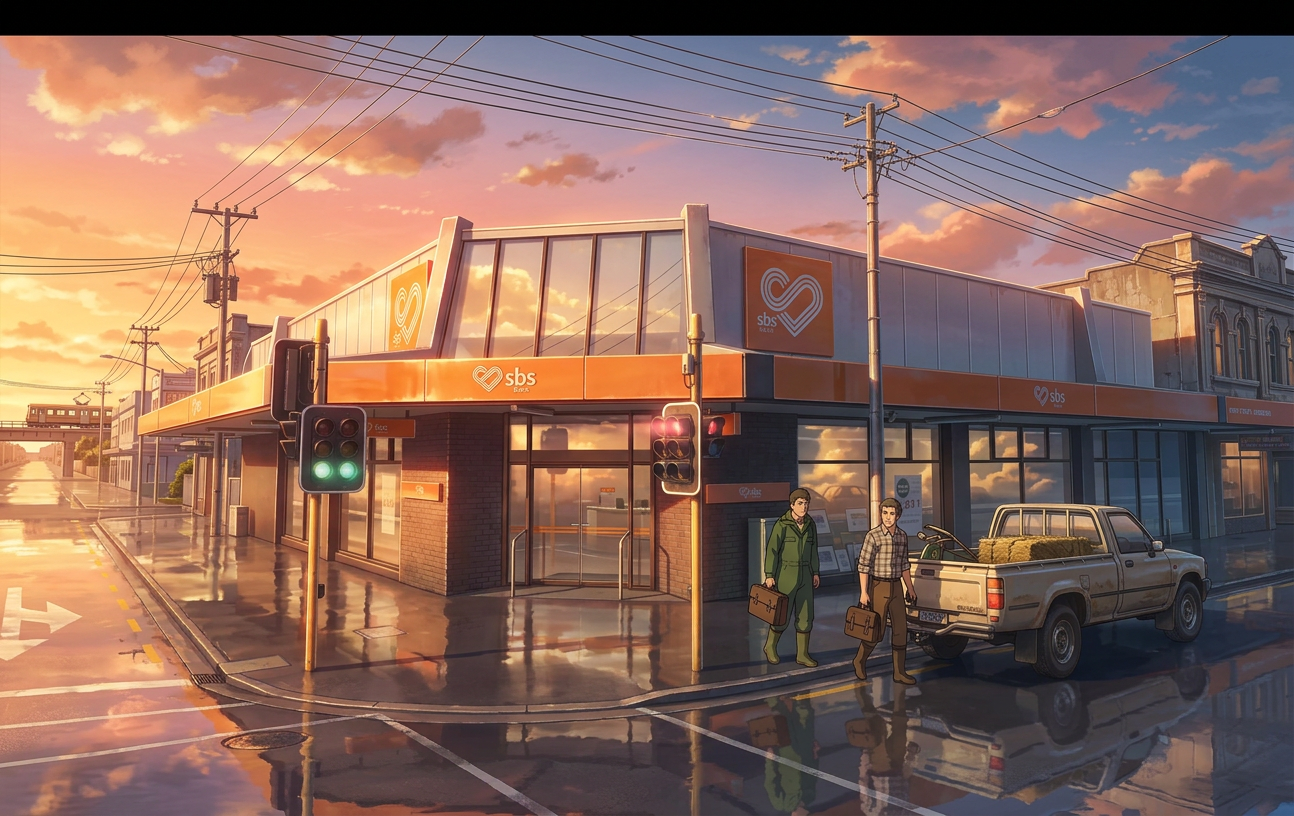
Three of the six banks that signed that closure notice on 10 February 1931 are now the same bank. ANZ absorbed the Union Bank of Australia, the Bank of Australasia, and the National Bank of New Zealand over the course of the following eighty years. When you walk past ANZ at 101 Queen Street West today, you are walking past the institutional descendant of three separate financial organisations that all had their premises destroyed on the same morning in 1931.
There is a kind of institutional memory built into the fabric of WestSide that has nothing to do with heritage listings or preservation grants. It is simply the fact that the same kinds of businesses — the banks, the legal firms, the accountants, the services that a city needs to function — have been on this strip for as long as the strip has existed.
They survived the fires. They survived the earthquake. They terminated their credit arrangements on 11 February 1931 and reopened in temporary premises by 16 February. They rebuilt. And when the next generation of bankers needed somewhere to put a branch in Hastings, they came back to the same street their predecessors had always used.
That is not sentimentality. That is where the money is. And where the money goes, the city follows.
Sources — Hawke's Bay Tribune 28 January 1932 · Evening Post 9 February 1931 · Wanganui Chronicle 10–11 February 1931 · Stuff.co.nz 2017 · MTG Hawke's Bay Collection object 76651 · Hawke's Bay Knowledge Bank · Hastings District Libraries Recollect · Te Ara Encyclopedia of New Zealand