
3 February 1931 — The Hawke's Bay Earthquake
The Street
at 10:47 am
Block by block, here is Heretaunga Street West as it stood on the morning of the earthquake — who was open for business, what they were selling, and what became of them.
Tuesday, 3 February 1931 · Magnitude 7.8 · 256 dead across Hawke's Bay · 10:47 am
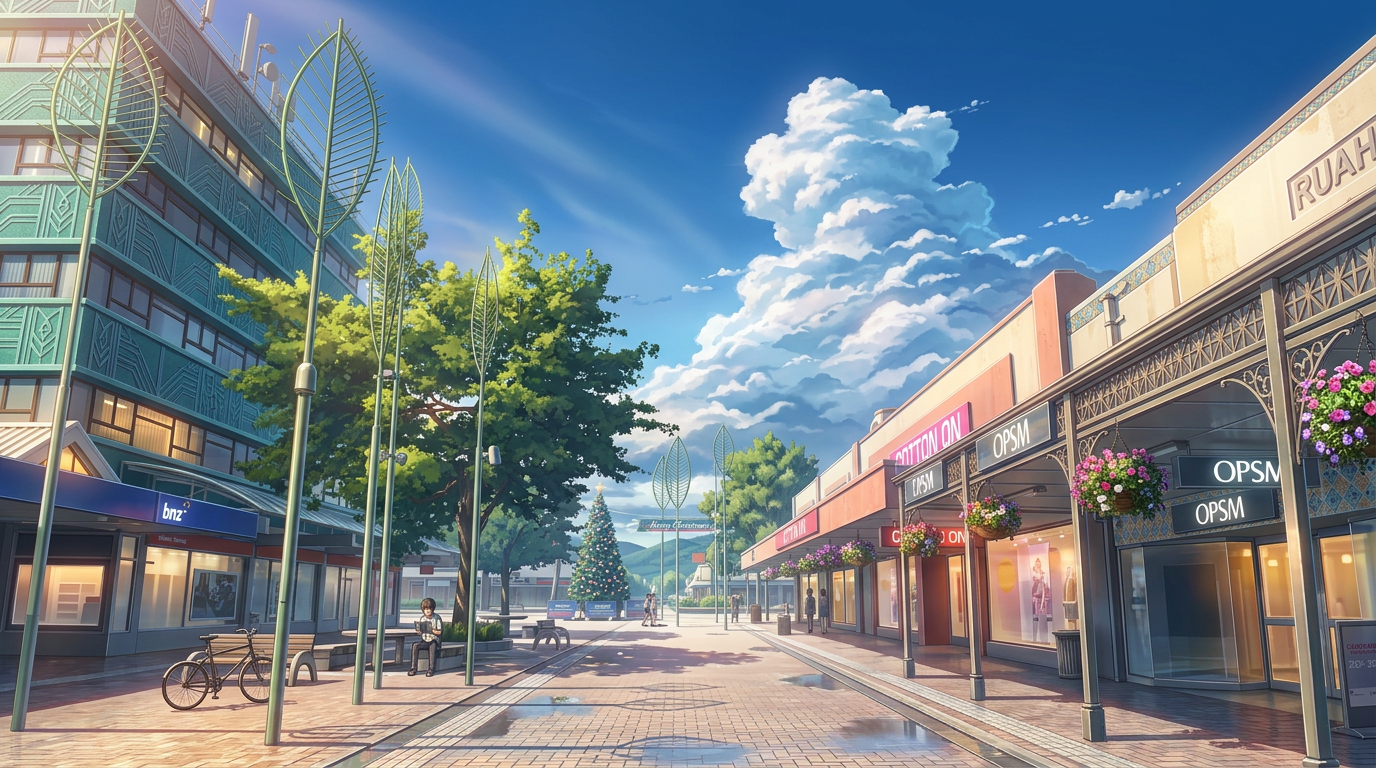
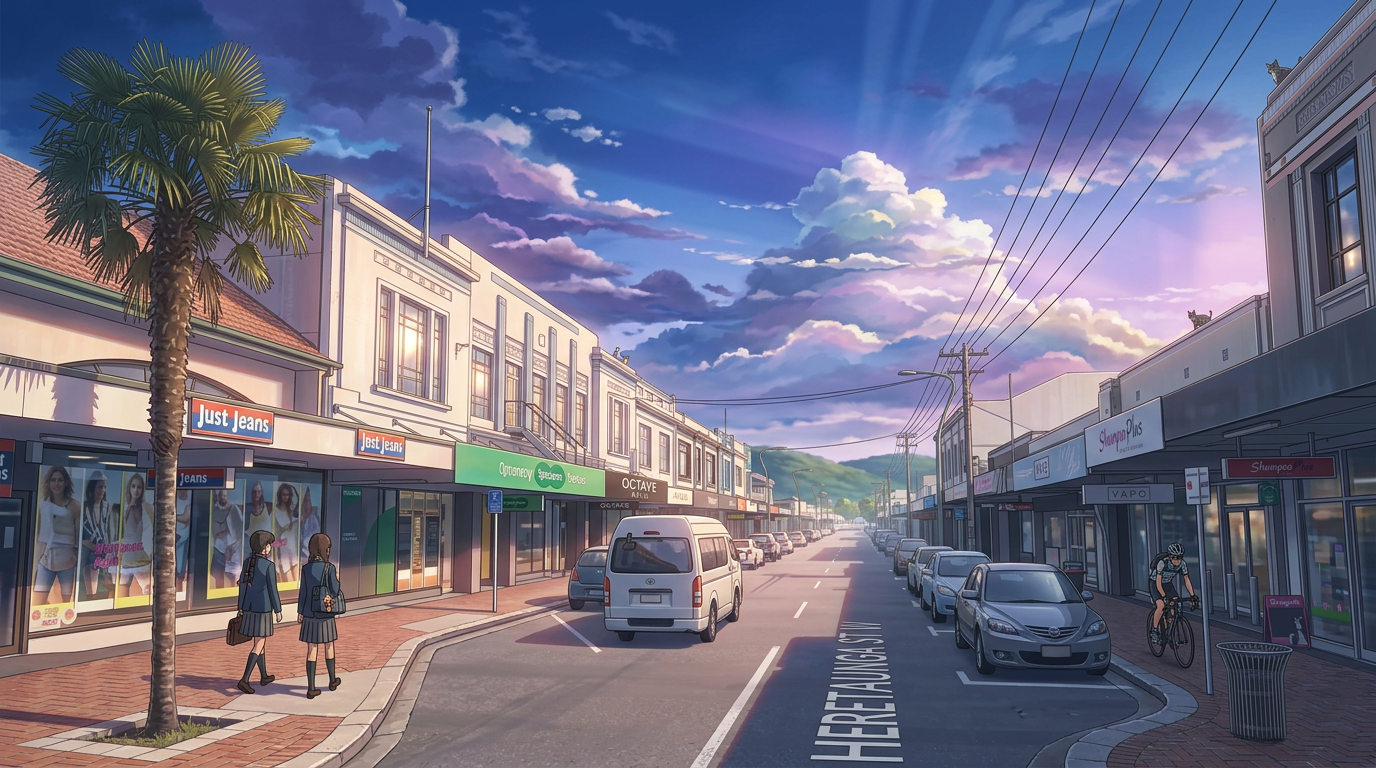
100–199 Heretaunga Street West
The railway end —
beer, boots and banks
to Market St
This block, nearest the railway crossing, was the oldest commercial core of the strip. It had already burned to the ground twice before the earthquake arrived — in February 1893, when fire started in McEwan's draper and took everything on both sides of the street, and again in May 1907 when the Williams and Kettle fire destroyed the rebuilt east block. What stood here in 1931 was largely only two decades old. Two photographs taken in the minutes and hours after the earthquake survive at MTG Hawke's Bay — between them they name fifteen businesses in this single block.
Post-earthquake photograph — eyewitness record
"The exterior walls have fallen, exposing the interior. Behind this building is the Bank of New Zealand and the Bank of New South Wales. Businesses visible include Baird's Drapers, The New Zealand Clothing Factory, and Foster Brooks. The Pacific Hotel stands at the intersection of Heretaunga Street and Market Street."
MTG Hawke's Bay, object 97555, 3 February 1931Archival images — 100 block
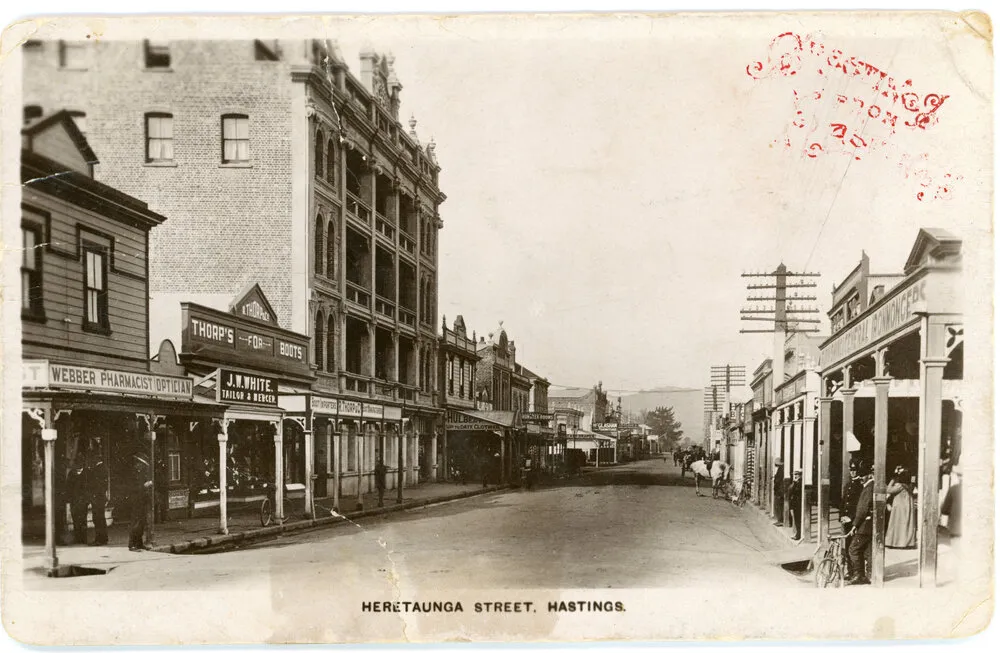
South side — left, walking west
- Woodward's PharmacyLost
- Bank of New South Wales (Market St corner)Rebuilt
- Griffith's Boot CompanyLost
- Bank of New ZealandRebuilt
- H.R. FrenchLost
- Hall's Book ShopLost
- J.R. MacKenzieLost
- H.J. Lovell-Smith, PhotographerLost
- Phillip Schneidemann, TailorLost
- Pacific Hotel (Market St corner)Survived
North side — right, walking west
- Club Tearooms — walls collapsed, interior exposedLost
- Baird's DrapersLost
- NZ Clothing Factory (Hallensteins Brothers)Lost
- Foster BrooksLost
- Hastings Hotel — survived; demolished 1960sSurvived
What's there now
The Hastings Hotel survived the earthquake but was demolished in the late 1960s to make way for Woolworths — later New World. The Pacific Hotel corner was redeveloped in subsequent decades. The railway level crossing at the eastern end of this block remained active well into the 1960s. Almost everything you see here today was built in the 1932–35 Art Deco reconstruction.
H.J. Lovell-Smith, whose photography studio was destroyed in the earthquake, was the same Lovell-Smith whose name appears on photographs documenting the disaster taken across the district that morning. He photographed the destruction that had swallowed his own business.
200–299 Heretaunga Street West
The Piccadilly block —
tea, cycles, and a department store
to King St
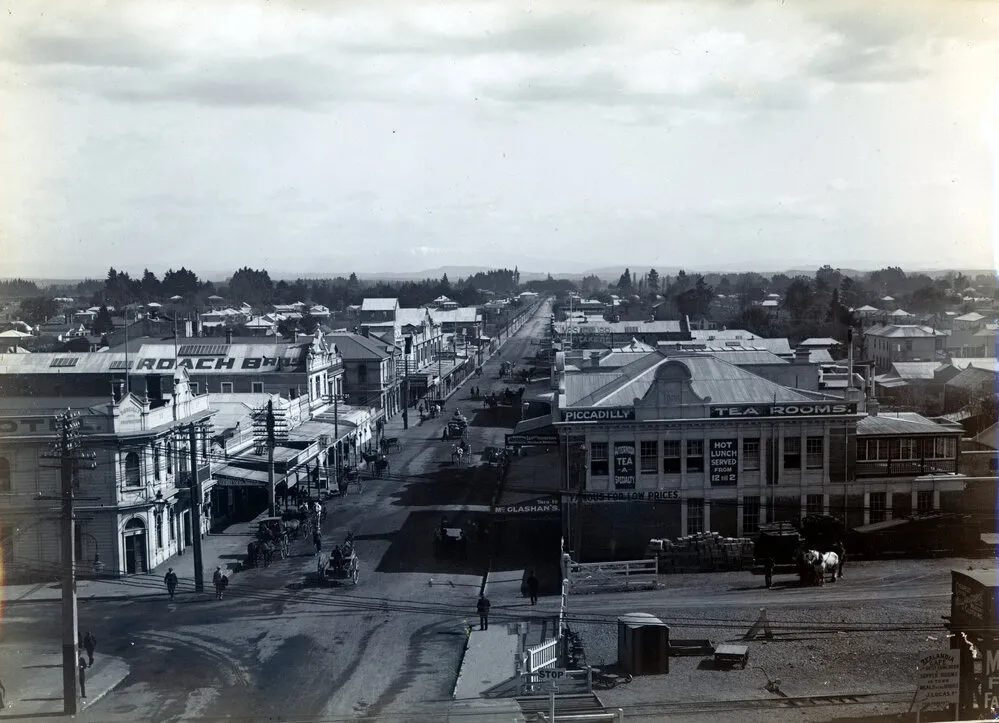
This block ran from Market Street to King Street — and at its western end, anchoring the King Street corner at 244 HSW, stood Roachs' Department Store: the building that killed seventeen people in 71 seconds. East of it, filling the block toward Market Street, was Hastings's social midpoint — the Piccadilly Tea Rooms, hairdressers, a cycle shop, a house furnisher, an undertaker. At least six photographic postcards document the Piccadilly alone, between c.1900 and c.1913. Together these two buildings — a tea room and a department store — defined the public life of this block for three decades.
The Piccadilly Tea Rooms, c.1900–1931
A c.1908 postcard held at the Hawke's Bay Knowledge Bank records the building's own sign in legible detail: "Piccadilly Tea Rooms 1908 — Afternoon Tea a Specialty — Hot Lunch Served from 12 till 2." A c.1913 Recollect photograph looking west from the railway line places it on the northern corner of Heretaunga Street and Railway Road, sharing the frame with Roach Brothers, Horne and Joll Hairdressers and Tobacconists, the NZ HB Clothing Factory, Tombs and Crubb Undertakers, and Miss Harding Ladies Hairdresser. A c.1910 Clapham Series postcard adds Jones Cycles and David Whyte Furnishers to the picture.
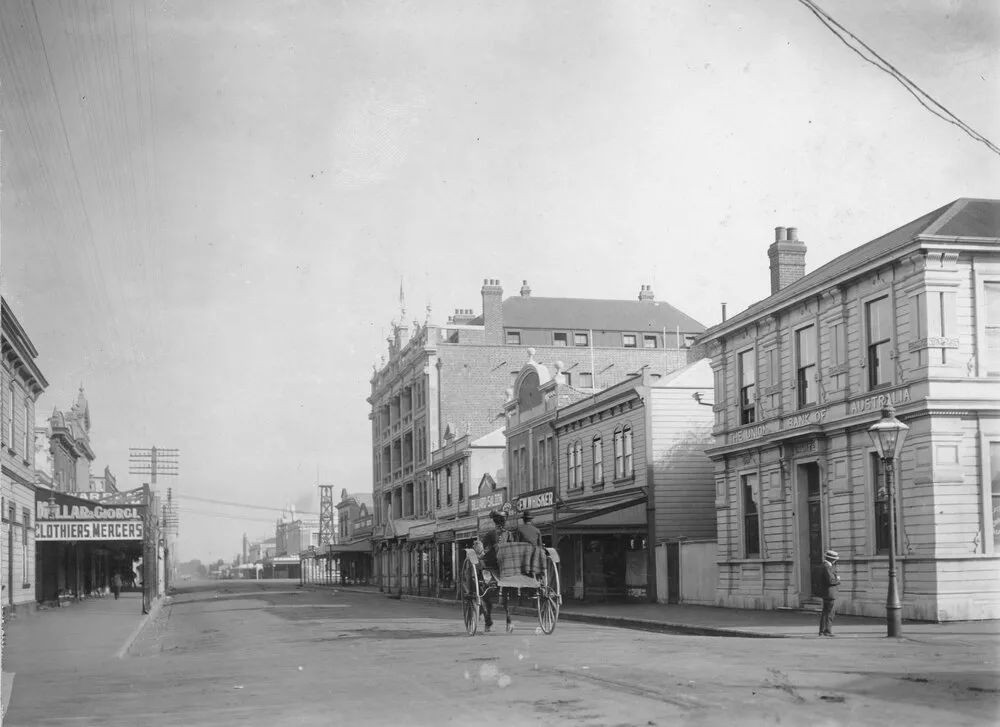
A further c.1910 Recollect photograph looking west along Heretaunga Street East places the Piccadilly alongside the Grand Hotel, Millar and Giorgi Clothiers, and the Union Bank of Australia. These records, taken together, produce an unusually complete picture of the block across nearly three decades before it was destroyed. On the morning of 3 February 1931, the Piccadilly had been open for lunch service for less than two hours.
Images: Hawke's Bay Knowledge Bank (CC BY-NC 4.0) — DigitalNZ 44008951, 44008947. Hastings Recollect (CC BY-NC-ND 4.0) — DigitalNZ 53382505, 54493636, 59984095, 59984086.
1908 postcard — sign on the building
"Piccadilly Tea Rooms 1908. Afternoon Tea a Specialty. Hot Lunch Served from 12 till 2."
Hawke's Bay Knowledge Bank, DigitalNZ 44008947 (CC BY-NC 4.0)Archival images — 200 block

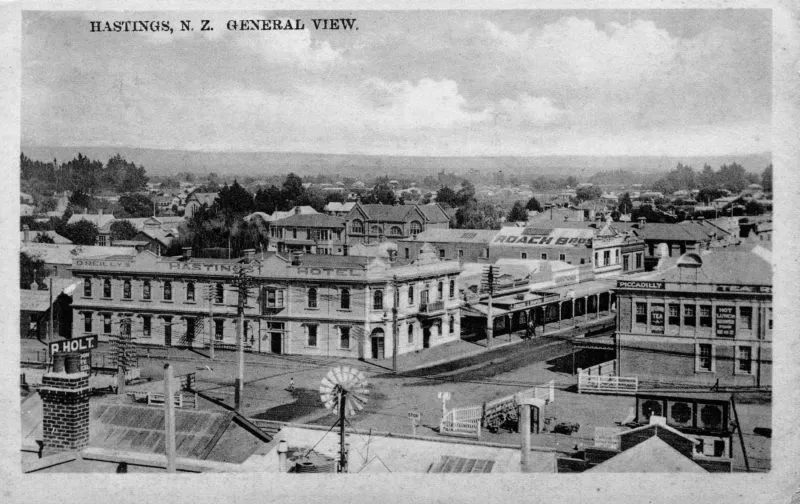
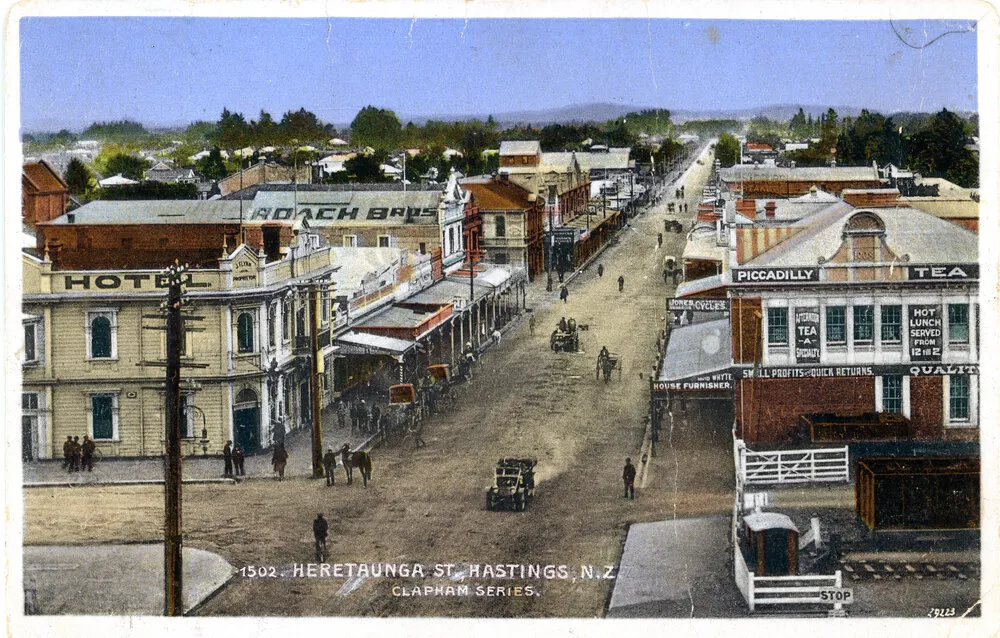
South side — left, walking west
- O'Reilly's Hastings Hotel (Railway Rd corner)Survived
- Bank of New South Wales (Market St corner)Rebuilt
- Maddison's DraperyLost
- J.W. Gower's Café (above Maddison's)Lost
- Pacific Hotel (Market St corner)Survived
- James Donovan, Hairdresser, 306 HSWUnknown
- H.K. Thomson, clothier/draper (King St area)Lost
North side — right, walking west
- Piccadilly Tea Rooms (Railway Rd corner)Lost
- Horne and Joll, Hairdressers & TobacconistsLost
- Miss Harding, Ladies HairdresserLost
- NZ HB Clothing FactoryLost
- Tombs and Crubb, UndertakersLost
- Jones CyclesLost
- David Whyte & Co, House FurnisherLost
- Millar and Giorgi, ClothiersLost
- Barley Bros, Tailors & MercersUnknown
- Roach's Department Store, 244 HSW (King St corner)Lost
Roachs' Department Store, 244 HSW — the morning seventeen people died
Roachs' had been on the King Street corner since at least 1883, when C.H. Roach is first visible in photographic records at this address. By 1915 a new Mission-style ferro-concrete department store had been built on the site. On 3 February 1931 it had 50 people inside at 10:47 am — customers and staff on a Tuesday morning in summer. Seventeen of them did not walk out.
The HDC Heritage Inventory records what happened: "The front of the building rose in the air before the structure collapsed in a heap... One was a boy who had gone in to buy a school cap." The removal of internal support pillars in the early 1920s — to create more display space — is thought to have contributed to the collapse. The boy buying the school cap was Rex Fredsberg, aged thirteen. The oldest victim was 58. A two-week-old infant was also carried in that morning and did not survive.
Two years earlier, in 1929, Roachs' had published a Christmas catalogue — millinery, menswear, gramophones, radios, groceries, electric goods — now held at MTG Hawke's Bay, marked Public Domain. It is a window into an ordinary Tuesday morning on this corner, two years before everything changed.
Hector Jones Electrical Co, King Street — the man who was overseas when it happened
On the King Street corner of this block, the Hector Jones Electrical Company traded as "Electrical Engineers & Radiotricians, Importers of High Grade Electrical and Radio Equipment." A staff photograph from 1931 shows one boy, four men, and two women at the front of the shop. By the end of 3 February, two of those staff were dead: Olive Cambridge (18, clerk, from Karamu Road) and Constance Horsley (33, widow, Southampton Street).
Founder Hector Jones was aged 37 and overseas in 1930. He did not see his building destroyed. He came back, rebuilt, and the business continued — the Hector Jones building features by name on the 1934 Central Hastings Photo Map, and a newspaper account from 2006 recalls a man who chose Hector Jones over a rival electrical firm in his post-war job search specifically because "they had a nicer looking building with big glass walls."
In 1984, Hector Jones sold the business to Leith and Sherrill Jennings. Their son is the current business owner at The Line gallery, 318 Heretaunga Street West — a thread that connects the electrical shop destroyed in the earthquake to a gallery on the same strip, four decades on.
What's there now
The 1934 Moderne building by Davies and Phillips replaced Roachs' on the King Street corner — its distinctive horizontal curves and corner rotunda made it the finest Moderne commercial building in Hastings. It became Westpoint Plaza in 1981 and Farmers in 2012. Most of the Moderne building was demolished for the Farmers fitout; the rotunda at the King Street corner was retained.
The rest of the block — the Piccadilly's end — was rebuilt in Art Deco style 1932–34. James Donovan's hairdressing at 306 HSW is one of the few pre-earthquake addresses on this block precisely located, confirmed in a January 1923 photograph. The Pacific Hotel survived the earthquake but was substantially redeveloped in later decades.
300–399 Heretaunga Street West
The Wade block —
the theatre, the electrician, and a woman who rebuilt
to Nelson St
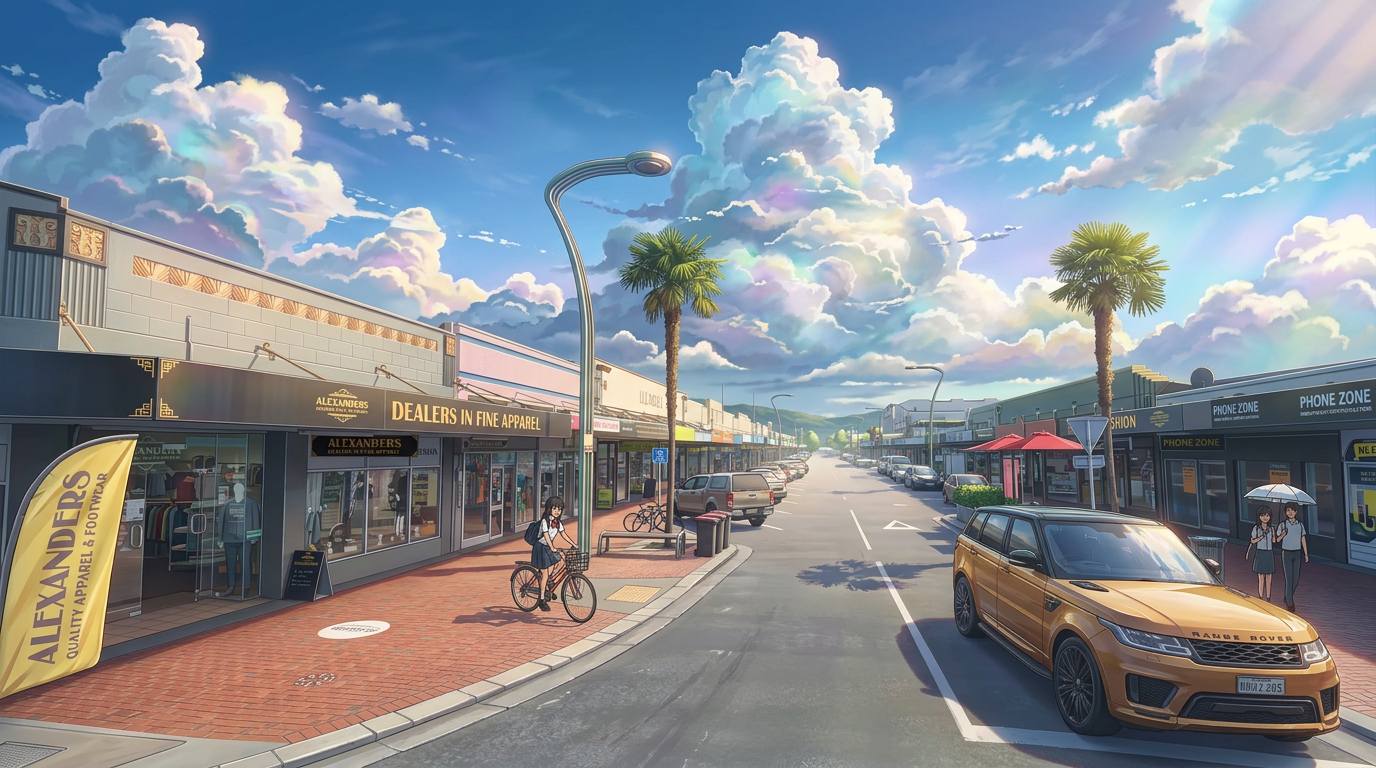
This block ran from King Street to Nelson Street. At its eastern end sat the Cosy De Luxe Theatre — where on the morning of 3 February eight people died inside or just outside the building. At the western end, James Kirk's Villa d'Este apartment building was barely two years old; Arthur Redgrave's grain and produce store had been there since 1924; Miss Emma Wade owned the corner on Nelson Street. All of it came down. But two things make this block singular: the woman who rebuilt the corner with earthquake compensation money, and the man who chose her rebuilt building — 25 years later — as the address for a shop his family still runs today.
Inscription on the earthquake photograph — MTG Hawke's Bay, object 77649
"Great earthquake 3/2/31 Heretaunga St — went with Villa de'Este Flats in foreground."
Handwritten note on reverse. MTG Hawke's Bay object 77649, 3 February 1931.Archival images — 300 block


South side — left, walking west
- James Kirk's Villa d'Este (built 1929)Lost
- Commercial tenants, Inv.31 buildingsPartial
North side — right, walking west
- Cosy De Luxe Theatre — Douglas Buildings, c.1914 (King St corner)Lost
- Haxton's Home Cookery (inside Cosy Theatre building)Lost
- Kirkpatrick Confectionery (inside Cosy Theatre building)Lost
- Phillip & Wright & Co, cabinet-makers, 411 HSWLost
- Miss Emma Wade's building (Nelson St corner)Lost
- A.F. Redgrave & Co, Grain & Produce Merchants (est. 1924)Rebuilt
- Electric Battery Service StationLost
- Cycle & Sports DepotLost
- Lewis & Sands, ButcherLost
The Cosy De Luxe Theatre — and those who died inside it
The Douglas Buildings were constructed around 1914 at the King Street corner of Heretaunga Street West — first as "Everybody's Picture Theatre" (confirmed as the venue for a land auction in December 1917), then as the Cosy De Luxe Theatre under W.R. Kemball Theatres Ltd. A 1922 photograph shows it with a large neon sign and Paramount Pictures billing: "The Best Show in Town."
Inside the theatre building on the morning of 3 February 1931 were at least three separate business tenants. Doris Haxton (28) and Sabina Haxton (26) — sisters — were at their pastrycook shop, Haxton's Home Cookery. Mary Kirkpatrick (45) was at her confectionery shop. All three died when the building collapsed. Margaret O'Neill (36), a dressmaker, also died in the Cosy Theatre building.
Outside on the footpath, a mother and her two small boys were passing: Ethel Cole (33), Peter Cole (3), and Billy Cole (4), all living at the Hastings Hotel. All three died outside the Cosy Theatre. Emma Cockerill (78) and Alice Wells (17) also died outside the building. William Bartle (61), a painter, was injured at the Cosy Theatre and died the next day at the Racecourse Hospital.
Eight deaths — inside and outside this single building — in less than a minute.
Miss Emma Wade — the woman who rebuilt the corner
Miss Emma Wade lost her building at the Nelson Street corner in the earthquake. With the compensation money she received, she commissioned architect Edmund Anscombe to design replacement premises at the same address. The result — completed 1932 — is the Wade Building that still stands at 353–359 HSW today: horizontal Art Deco banding, a distinctive corner pilaster treatment, and a shopfront rhythm that Anscombe used across several Hastings commissions in this period. It is the finest Art Deco facade on the strip.
She also had Anscombe plan the property next door — documented in his original 1932 drawings as a "battery bay" and two garages. That building, 103–103A Nelson Street North, is now Bistro 103. Both were Miss Wade's investment. Both were built at the same time, to the same architect's drawings, with the same earthquake compensation money. The concrete drive-through kerbing from the original garage is still visible inside today.
We do not know where Miss Wade went after the earthquake, or when she first acquired the properties, or whether she ever lived above her shops. What the record shows is that when the dust settled, she built — and what she built has outlasted her by at least ninety years.
Mick Thomson — a life that connected two eras of the street
In 1928, fifteen-year-old Harry Knight Thomson — known as Mick — left school to work at Blackmore's Clothing Shop in Heretaunga Street. He was still there on the morning of 3 February 1931 when the earthquake struck. Blackmore's survived. He kept working — through the war, through his return, until the founder's son took over as manager and Mick began looking quietly for his own place.
A real estate agent friend told him about an empty ladies' shop at 355 HSW — too far west, Mick thought. The reply has become the most quoted line in the Thomson family history: "If you want to succeed, go west young man."
In 1957, Thomson's Suits opened in the Wade Building — the building Miss Emma Wade had built with her earthquake compensation money twenty-five years earlier. Son Michael joined in 1966. Grandson Angus in 1998. Three generations. Same address. Still open.
What's there now
The Cosy Theatre site at 301–309 HSW was rebuilt by Fletcher Construction in 1932 — their largest Depression-era contract — in Spanish Mission style. That building still stands today as Music Works and Hustle Surf and Moto: the curved white render, terracotta tile detail, and arched entrance that make it the most visually distinctive facade on the strip.
The Wade Building (353–359 HSW) still stands — still the finest Art Deco facade on the strip. A.F. Redgrave and Co re-established itself in the rebuilt Inv.28 building and traded for 64 years (1924–1988). The Art Nouveau plasterwork lettering "A F Redgrave & Co. Ltd." is still readable on the facade. The garage at 103–103A Nelson Street North — now Bistro 103 — still has the original Anscombe-designed concrete drive-through kerbing inside. And at 355 HSW, Thomson's Suits is still open.
400–499 Heretaunga Street West
The far end of the street —
the stables, the pie shop, the western edge
and west
Beyond King Street the strip thinned out and changed character. The London Pie Shop, Gallagher's Produce, and the Novelty Depot filled the eastern portion of this block. Further west, Graham and Gebbie's Premier Stables at 351 HSW — Motor Car for Hire, Royal Mail Coach departures, livery and feed — gave the block a working feel distinct from the commercial density closer to the railway. This is the least well-documented section of the pre-earthquake strip in the surviving photographic record. The camera rarely pointed this far west.
Premier Stables, 351 Heretaunga Street West
"Royal Mail Coach Leaves for Sherenden, Tuanui, Glenross... Mrs Jones Art Needlework & Fancy Goods was next to the later London Pie Shop opposite Roach's. Graham & Gebbie later acquired Tattersall's stables in Market St south."
Martin Beck, An Historic Image Compilation of Early Hastings, 2014 (F.G. Radcliffe photograph caption, 1910)Archival images — 400 block

South side — left, walking west
- Novelty Depot (near King St)Unknown
- Various west-end tenantsUnknown
North side — right, walking west
- London Pie Shop (west of King St)Lost
- Gallagher's & Co Provisional ProduceLost
- Mrs Jones Art Needlework & Fancy GoodsUnknown
- Graham & Gebbie, Premier Stables, 351 HSWUnknown
- Further west-end tenantsUnknown
Graham & Gebbie — Royal Mail and motor cars at 351 HSW
At 351 Heretaunga Street West, Graham Brothers operated Premier Stables from at least 1910, offering Motor Car for Hire alongside the Royal Mail Coach departing for Sherenden, Tuanui, and Glenross. By 1912 the partnership had become Graham and Gebbie. They later acquired Tattersall's Stables in Market Street South. By 1931 the stables had likely evolved to another use. Their earthquake fate has not been confirmed in the photographic record.
Source: Beck 2014 (F.G. Radcliffe photograph captions, 1910–1912).
What's there now
The western portion of this block — beyond King Street toward Southland Road and the far end of the strip — was rebuilt in the 1932–35 reconstruction. The buildings you see today mostly date from that period. The western edge of WestSide is the least fully documented section of the pre-earthquake strip, and research into it is ongoing.
If you have photographs, street directories, family memories, or business records relating to this section of Heretaunga Street West before 1931, we would like to hear from you at hastingscity.nz.