
Hastings CBD
WestSide
Hastings, 1926. Monster stock-taking sales. Diamond rings and the largest selection in H.B. Fuji silk at 2/11 a yard. A bicycle race outside the Stortford Lodge Hotel. And somewhere in the distance, the Jazz Age.
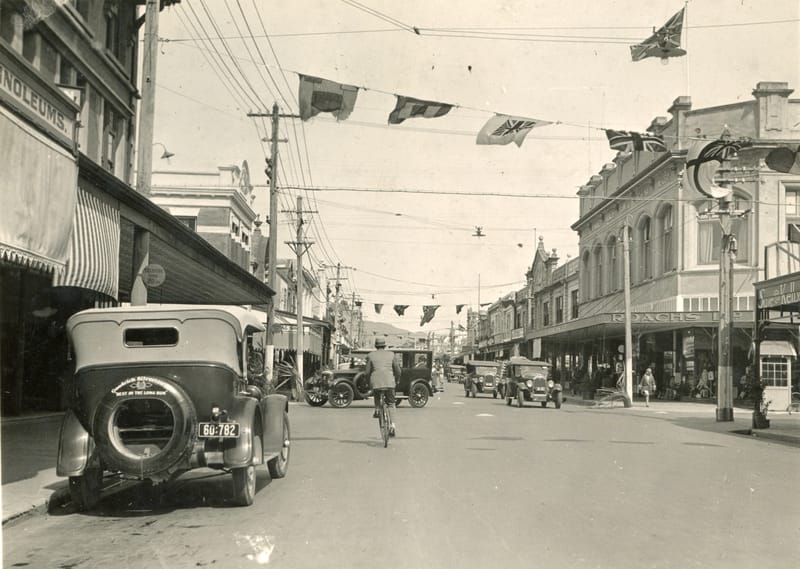 Heretaunga Street looking east from Roach's Corner · 1930s · Hastings War Memorial Library Collection · Library ID005093 · CC BY-NC-ND 4.0 · Hastings District Libraries Recollect
The flags are up. Cars are parked at angles on the unsealed road. A cyclist moves through the middle of the frame. On the right, Roach's Department Store...the largest retail operation in Hawke's Bay...anchors the corner of Heretaunga and King Streets. The overhead wires carry electricity to a town that has been wired since 1912.
This is Heretaunga Street in the 1930s... but close enough to 1926 that the bones are the same. The street is the same. The buildings are the same. The business names are the same. In 1926, Hastings was a town of about eight thousand people, and Heretaunga Street was the place where you spent your money, ran your errands, and found out what was on at the picture theatre.
What you could do on that street...and what was happening everywhere else in the world the same week...says something about what Hastings was, and what it had become in the forty years since two men sat down in a timber building beside Beck's Store and waited for their first banking customer.
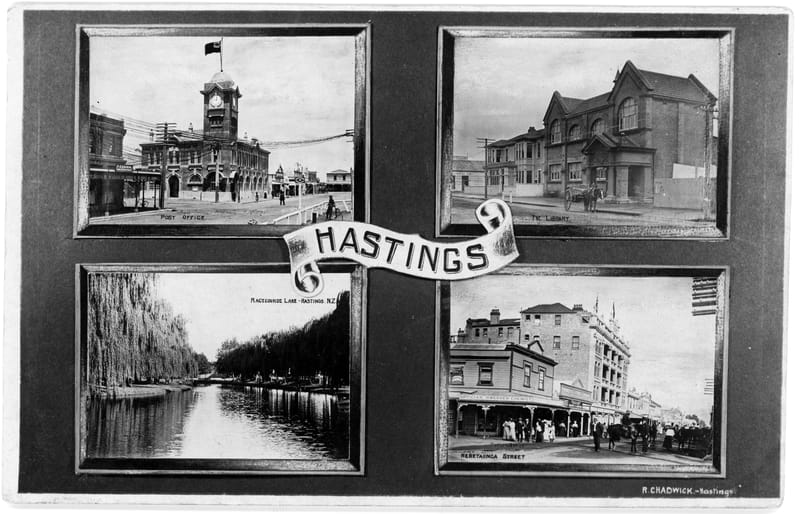 Hastings postcard · Post Office · Carnegie Library · Racecourse Lake · Heretaunga Street with Grand Hotel · c.1910s · R. Chadwick photographer · Hobbs Collection · Library ID007485 · CC BY-NC-ND 4.0 · Hastings District Libraries Recollect
The street wasn't always called Heretaunga. In 1886, the newly formed Hastings Borough Council was advised that what they wanted to call Victoria Street was already taken further east. So they chose a different name for the Havelock-Omahu Road running through the town. They named it Heretaunga Street...after the plains it crossed.
Those plains had been leased from Māori in the 1860s by Thomas Tanner, who acquired the freehold and became one of the area's largest landowners. When the question of who founded Hastings came up in a public letters dispute in 1920, the answer was more contested than anyone expected.
The honour belongs to the late Mr F. Hicks, who bought 100 acres on the north side of what is now known as Heretaunga Street. The 100 acres on the south side were bought by the late Mr James Boyle. Mr Hicks soon after put his lot up for a township, giving it the name of Hastings...I presume after the renowned Warren Hastings.
Warren Hastings...the man the town was named after...was born in 1732, became Governor-General of Bengal, and died in 1818. He never came near New Zealand. But his name arrived here anyway, carried across by a settler who admired him, and planted on 100 acres of Hawke's Bay flatland that would become the most commercially active street in the region.
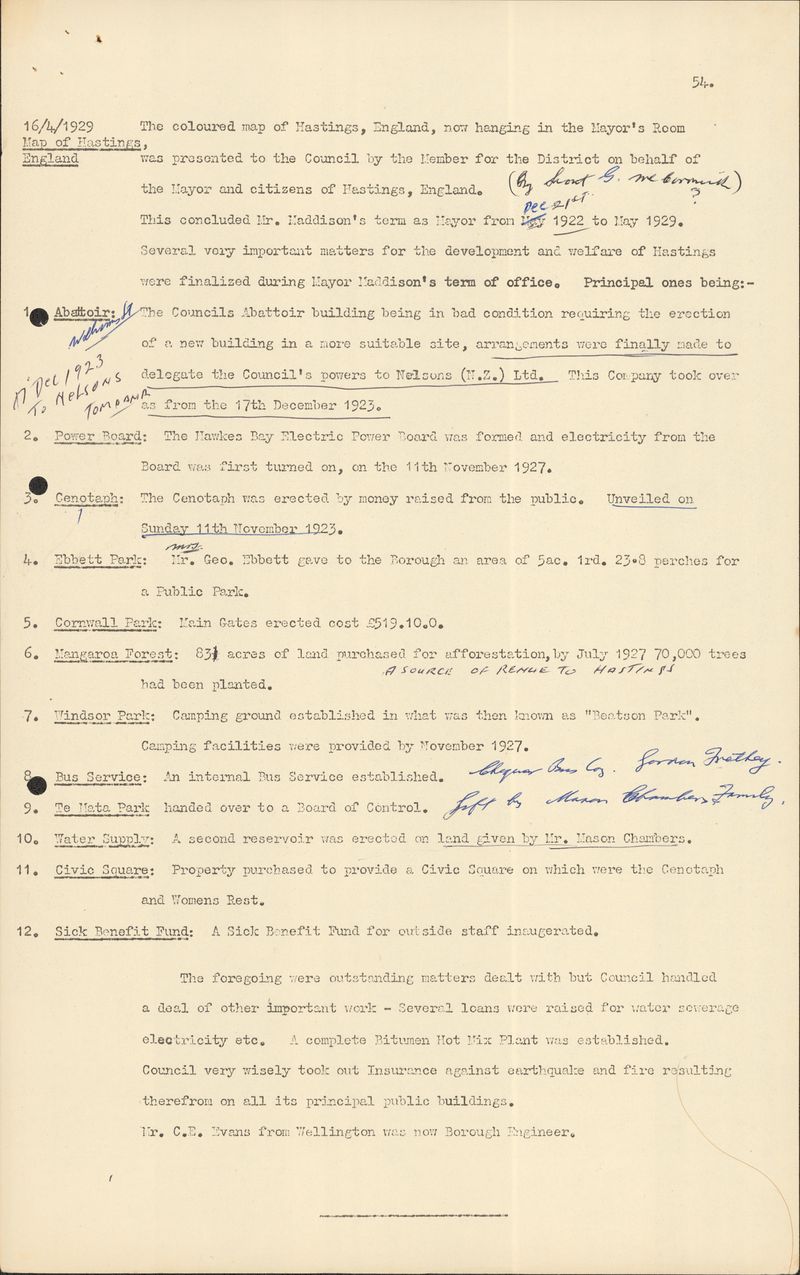
By the time the first Borough Council met on 20 October 1886, the population was 1,504...more than double what it had been two and a half years earlier. The largest Borough area in New Zealand at 5,760 acres. The first mayor was R. Wellwood. The council's first acts included naming Heretaunga Street, drawing up the first set of by-laws, authorising the purchase of a fire bell weighing not less than 200 lbs, and fixing the dog tax at 10 shillings for greyhounds and lurchers, 5 shillings for all others.
By 1926, the town had been building itself for forty years. The council minutes...compiled by retired Town Clerk N.C. Harding and held in the Giorgi Collection...read like a city assembling itself piece by piece, decade by decade, from the inside out.
1912...Electricity. Tenders accepted for Power House and Plant. By 1 August 1912 the first 29 premises were wired and lit. 44 street lamps erected and lighted. By the end of the term: 294 electrical consumers in Hastings.
November 1919...The first motor truck purchased by the council. A 1-ton Ford. Eight months later, in July 1920, the council was still lobbying the Government to require driver's licences...no such thing existed yet in New Zealand.
May 1920...The Prince of Wales visited Hastings. Reception at the Racecourse.
11 November 1923...The Cenotaph unveiled. Funded by public subscription. A town that had sent its young men to Gallipoli and the Somme was now building a permanent memorial to them on the street they had grown up on.
11 November 1927...The Hawke's Bay Electric Power Board first turned on power from the regional grid. Before that, the town had been generating its own electricity since 1912. When the grid arrived, the old diesel engines fell silent and the Power Board's current came through the lines instead.
Parks. Schools. A technical college. A water supply. A sewerage system. An abattoir. A bus service. Cornwall Park, Windsor Park, Te Mata...handed to a board of control and open to everyone. A Memorial Hospital. The Carnegie Library, photographed on a postcard sent to someone in Johannesburg around 1910 with the handwritten note: "See our Post Office. Nothing like it in Joburg."
These are three advertisements from the Hawke's Bay Tribune in the winter of 1926. The same street. The same shops. The customers were the farmers who drove in from the plains, the families who lived in the residential streets to the north and south, and the workers who had been here since before the electricity went on.
J.R. McKenzie on Heretaunga Street. Monster stock-taking sales. Cumings the draper with Fuji silk at 2/11 a yard. S.O. Garland with the largest stock of diamond rings in Hawke's Bay. These were not small-town businesses making do. These were proper commercial enterprises, placing large advertisements in the regional newspaper, competing for the same customers with the same urgency and the same language that shops have always used.
The same week J.R. McKenzie was running its Monster Stock-taking Sale on Heretaunga Street, this is what was happening in the world:
In London, the General Strike of May 1926 had just collapsed after nine days...the largest industrial action in British history, 1.7 million workers, the Government broadcasting on the BBC and deploying the army to keep the buses running. In America, Prohibition was in its seventh year. F. Scott Fitzgerald's The Great Gatsby had been published the previous year to mixed reviews. Ernest Hemingway was finishing The Sun Also Rises. Fritz Lang was in production on Metropolis. The first talking picture...The Jazz Singer...was still twelve months away.
In New Zealand, the population was about 1.4 million. The first Labour government was still a decade away. Auckland was building its first suburbs connected by motorcar rather than tram. Wellington was a city of government and shipping. Christchurch had its plains and its cathedral. And Hastings...with its 8,000 people, its electricity grid, its cenotaph, its four parks, its Carnegie Library, its diamond rings and its Fuji silk...was doing what provincial New Zealand towns of its generation did at their best.
It was building a complete life. Not a satellite of somewhere else. Not waiting for Auckland to decide what was modern. It had its own picture theatre, its own newspaper, its own hospital, its own electricity supply. It had shops that stocked the same goods as shops in the capital. And it had a street...one specific street...where all of it came together on a Saturday morning.
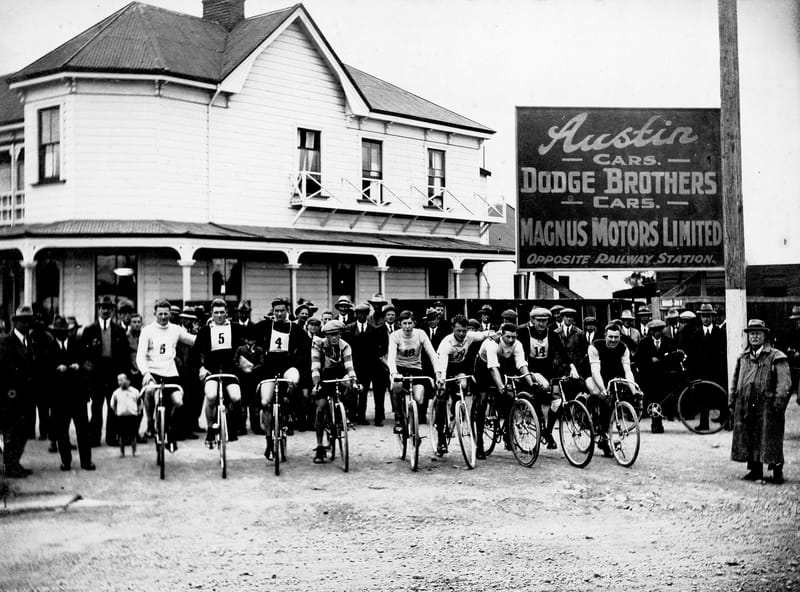 Bicycle race · Stortford Lodge Hotel behind · Magnus Motors Limited sign · Austin Cars · Dodge Brothers · H.N. Whitehead photographer · Trask Collection · Sports Collection · Library ID005367 · CC BY-NC-ND 4.0 · Hastings District Libraries Recollect
Arthur Lambert is the fourth competitor from the right, resting his hand on the shoulder of a fellow cyclist. Behind the starting line...a crowd of men in hats and caps, the kind of crowd you can only gather if the event is on a Saturday on the main street of a town where everyone knows the race is on.
And behind them all: the Stortford Lodge Hotel. And the sign. Austin Cars. Dodge Brothers Cars. Magnus Motors Limited. Opposite Railway Station.
That sign is doing a lot of work. By the 1920s, motor cars had arrived in Hastings in sufficient numbers that a dealership could afford large advertising hoardings and a prominent location opposite the railway station. The council had purchased its first motor truck...a 1-ton Ford...in December 1919. By 1920 it was already lobbying the Government to require driver's licences. The horse bus that had been the only way to Napier when the Bank of New South Wales opened in 1884 was already a memory.
Austin. Dodge Brothers. The same marques being sold in London and Detroit and Melbourne. On a sign in Hastings, opposite the station, in a photograph taken of a bicycle race sometime in the 1920s or 1930s. The world had arrived. The town was ready for it.
 Health, Wealth and Prosperity · Hastings Borough Council booklet · 1939 · Giorgi Collection · Library ID008154 · CC BY-NC-ND 4.0 · Hastings District Libraries Recollect
By 1939, the council had published a booklet about itself. Seventy-two pages. "Health, Wealth and Prosperity." Mayor Maddison's foreword. Photographs of the councillors. History, sports and community clubs, municipal facilities, churches, schools and parks. Advertising.
The booklet explained where the name Hawke's Bay came from...Captain Cook naming it after Lord Hawke, First Lord of the Admiralty, who saved England from French invasion in 1759. It explained who Warren Hastings was. It listed the clubs and the churches and the schools.
It was the kind of booklet a town publishes when it is proud of what it has built. And by 1939, Hastings had built something remarkable. Not because of any single decision or any single person, but because generation after generation of people who lived on the Heretaunga plains decided that what they had was worth improving...and then improved it.
"The man who owned the land and formed the township and gave it a name was the 'father' of Hastings. I suppose I must be the 'godfather,' having been the first Mayor."
R. Wellwood · First Mayor of Hastings · Letter to the editor · 7 December 1920 · Hastings District Libraries Recollect (CC BY-NC-ND 4.0)
The Heretaunga Street of 1926...the one with Cumings the draper and S.O. Garland the jeweller and J.R. McKenzie's Monster Stock-taking Sale...was the street that the Art Deco city was built on top of. The people who were shopping there in 1926 were the same people who would rebuild it five years later, and who would write their names into the plasterwork above the verandah line so that those names would still be there a century on.
That continuity is the thing. Not a single dramatic event. Not a founding moment or a founding father. Just a street, forty years in the making, doing what streets do...connecting people to the things they need, and to each other...until the day it stopped, and then starting again in a new shape on the same ground.
Sources...Hawke's Bay Tribune 5 June, 27 July, 30 July 1926 · N.C. Harding, History of Hastings: From Minutes of Council Meetings 1884–1963 (Giorgi Collection, Library ID008132, CC BY-NC-ND 4.0) · Hastings Borough Council, Health Wealth and Prosperity, 1939 (Giorgi Collection, Library ID008154) · R. Wellwood letter, 7 December 1920 (Recollect CC BY-NC-ND 4.0) · Hobbs Collection postcard c.1910s (Library ID007485) · Trask/Sports Collection bicycle race photograph (Library ID005367) · HWML Collection Heretaunga Street photograph (Library ID005093) · All Recollect images CC BY-NC-ND 4.0 International · hastings.recollect.co.nz