
Hastings CBD
WestSide
Five photographs taken during the Hastings Blossom Festival, 1956 to 1969. Not about the festival. About what the strip looked like when 50,000 people came to watch it.
The Blossom Festival began in 1950. A Greater Hastings initiative, started partly to show up Napier, it grew through the decade into one of the largest street events in New Zealand. By its peak in the mid-1950s, estimates put the crowd at 40,000 to 50,000 people lining Heretaunga Street. Four special express trains ran from Wellington. The 1954 parade had 63 floats.
The photographs taken during those years were almost all pointed at the arches, the floats, the crowds. That is understandable. But in the background of every one of them is something else: a precise record of what was trading on WestSide at that moment. The shop signs. The buildings. The cars at the kerb. The people crossing the street who were not part of the parade.
This article is about what those backgrounds show.
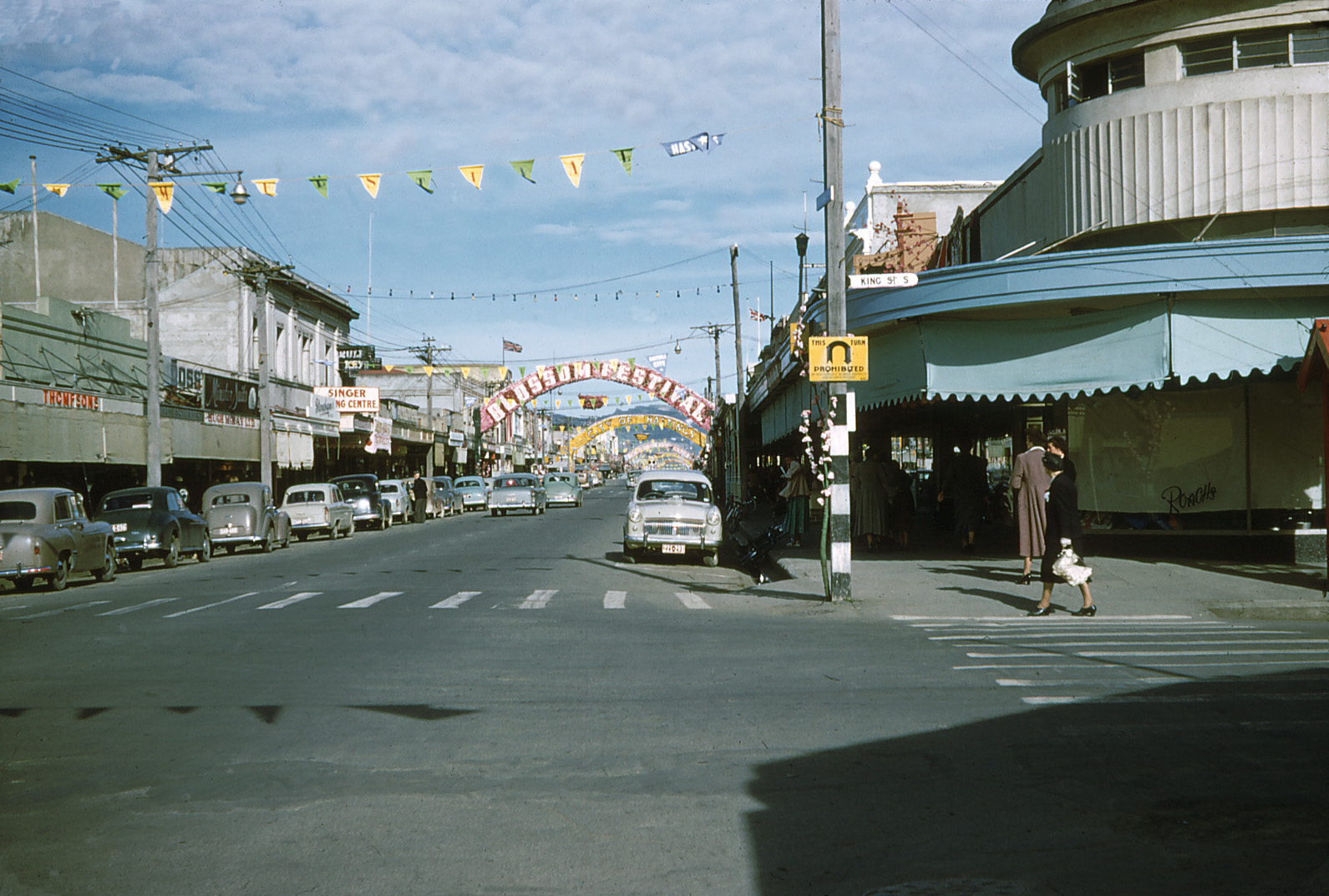 Blossom Festival 1956 · Heretaunga Street West looking east from King Street South corner · Singer Sewing Centre and Thompsons visible left · Roach's Art Deco corner building right foreground · Knowledge Bank accession 797569 · Hastings District Libraries · CC BY-NC-ND 4.0
This is the 1956 photograph. The photographer is standing at the intersection of Heretaunga Street West and King Street South, looking east. The "BLOSSOM FESTIVAL" arch is mid-distance, red and gold, strung with bunting the full width of the street. Behind it, more arches recede toward the clock tower.
But look at what is in the foreground.
On the right, the rounded corner of the Art Deco building that housed Roach's. The "KING ST S" sign is on the pole. A "THIS TURN PROHIBITED" sign below it. A woman in a full skirt is crossing, a small dog at her heels, carrying shopping. She is not watching the festival. She is going somewhere.
On the left, the Singer Sewing Centre is clearly signed. Next to it, "THOMPSONS." A continuous verandah runs the length of both sides, the characteristic covered walkway that survived the 1931 earthquake rebuild and defined how people moved along this street for the next forty years. The buildings are two-storey throughout. The ground floor retail. The upper floors offices, storage, sometimes accommodation.
This is 1956 Heretaunga Street West at its fullest expression. Full tenancy. Full street. The city has just been proclaimed a city... Hastings was granted that status in 1956, the year this photograph was taken. The Blossom Festival that year was the first one held in a city rather than a town.
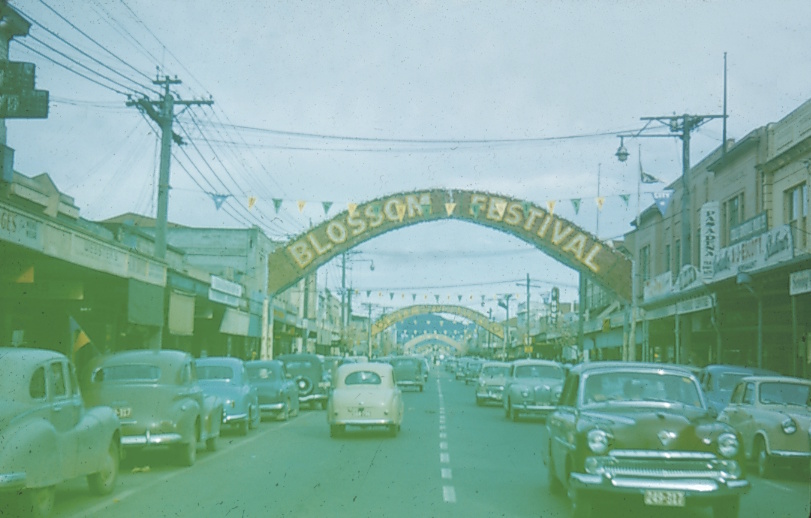
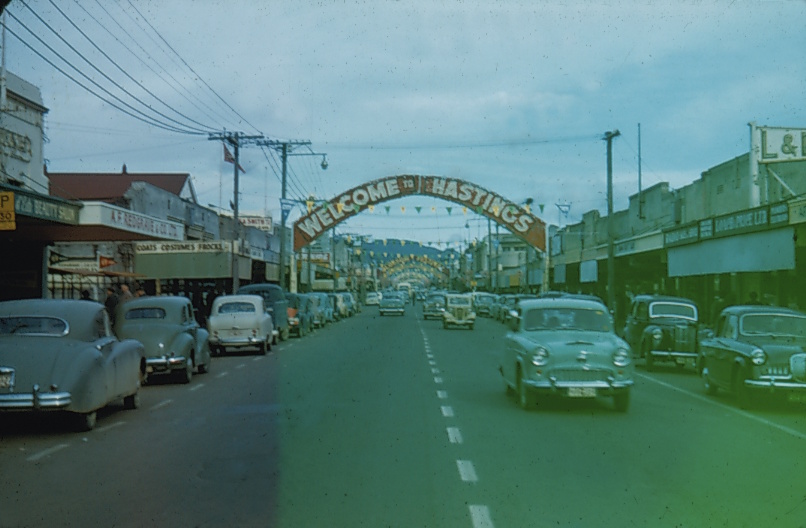
These two photographs are from the Clapperton Collection, both taken looking east along Heretaunga Street West. The teal cast is characteristic of 1950s 35mm slide film that has deteriorated slightly with age. Both show the same street in the same era but reveal different arches.
The left image carries the "BLOSSOM FESTIVAL" lettering. The right carries "WELCOME TO HASTINGS." Both show the same essential structure: multiple arches strung across the road at regular intervals, bunting between them, the street full of angle-parked late-1950s American cars. Austin Cambridges. Holdens. A Morris Minor in the middle distance of the left frame.
What these photographs confirm is that the decoration was not concentrated at one end of the strip. Multiple arches across the full length of Heretaunga Street West meant every block was dressed. The event did not happen at one point on the street. The street was the event.
On the left image, the buildings on both sides are single to two-storey, verandahed, continuous. No gaps. No vacant sites. A "VACANCY" sign is visible on an upper floor on the right... but this is likely a flat or office vacancy, not a retail vacancy. The ground floor retail in both images shows active, fully tenanted shopfronts.
The right image shows "COATS COSTUMES FROCKS" on the left side, and what appears to be a beauty salon sign. On the right, partially visible, "L&" something... possibly L&M or a similar two-initial trading name common in the period. These are all ground-floor retail. Clothing, fashion, beauty... the same categories that define this stretch today.
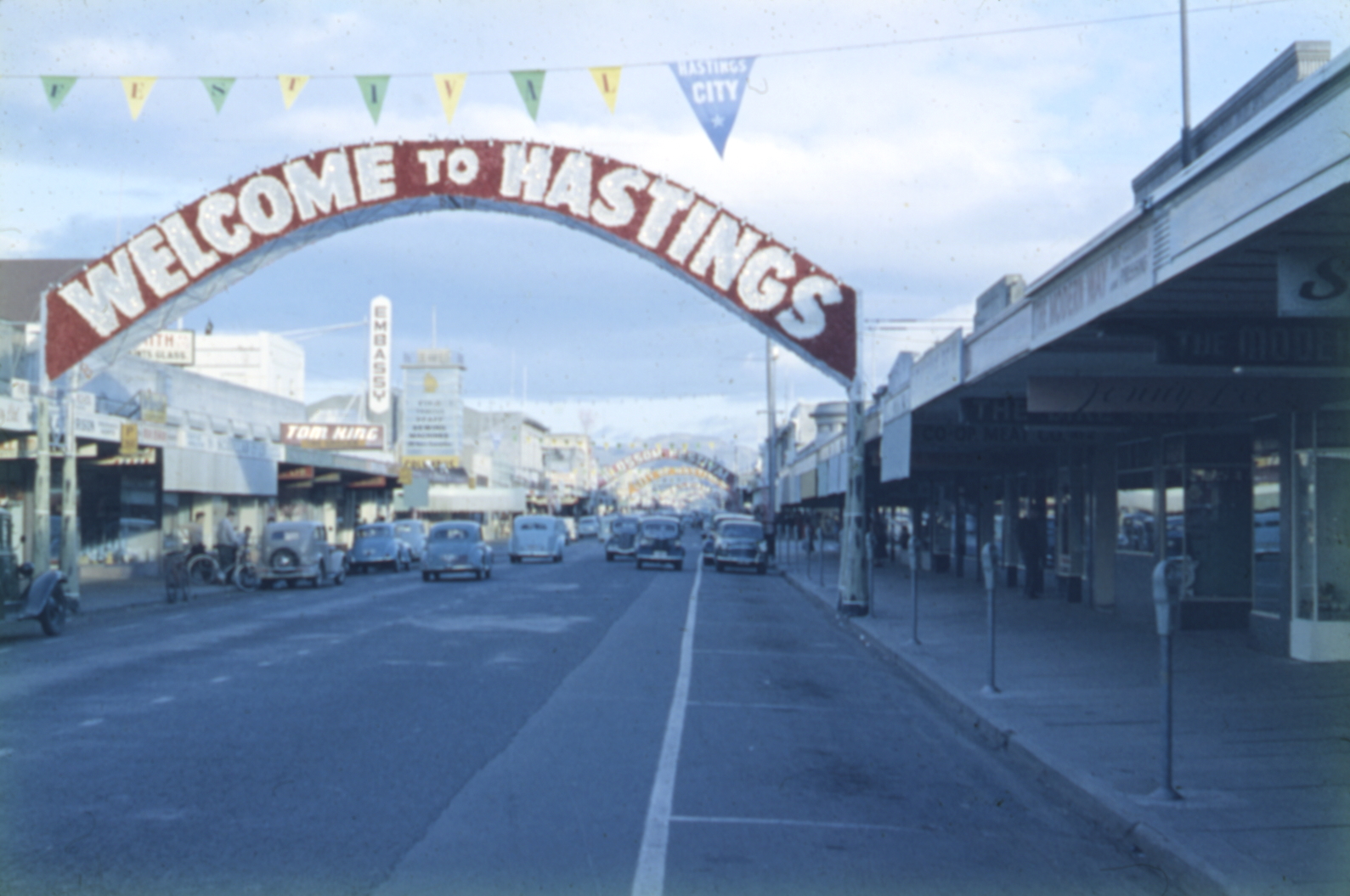 Blossom Festival 1958 · "Welcome to Hastings" arch · Embassy Cinema sign visible left · Tom King below it · "Hastings City" pennant on bunting · Hill/Pomeroy Collection · Knowledge Bank accession 540/546/23101 · Hastings District Libraries · CC BY-NC-ND 4.0
This 1958 photograph is taken further east along the strip, closer to the railway end. The "WELCOME TO HASTINGS" arch is in the foreground, its lettering large enough to read clearly. The blue cast is more pronounced here... the slide has shifted toward blue rather than teal with age.
On the left, the Embassy Cinema sign is readable... a vertical sign running down the building face, "EMBASSY" in large letters. Below it, "TOM KING." The Embassy was one of several cinemas on or near Heretaunga Street in this period. Cinema was the dominant entertainment format before television arrived in New Zealand in 1960, and the street's entertainment character in 1958 was still fully intact.
A "HASTINGS CITY" pennant hangs from the bunting... the city status, granted in 1956, was still new enough to be worth celebrating on the street decorations two years later.
On the right, a wide covered verandah runs unbroken. The street is quieter than in the other photographs... this may be early morning, before the crowds arrived. The cars parked on the right are a different mix: a large American sedan of late 1950s vintage, a utility vehicle. The footpath under the verandah is empty.
The street was not a backdrop to the festival. The festival was a proof of the street.
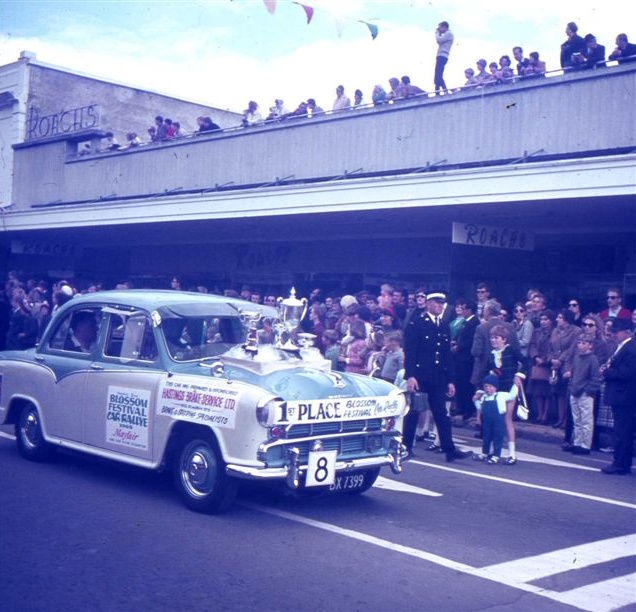 Blossom Festival Parade 1969 · 1st Place Car Rally · Hastings Brake Service Ltd · Roach's department store visible behind — crowd watching from the verandah roofline · Tobin Collection · Knowledge Bank accession 807443 · Hastings District Libraries · CC BY-NC-ND 4.0
This is thirteen years after the 1956 photograph. The parade has been running continuously since 1950... this is its nineteenth year. The first car has just come through... an Austin Cambridge sedan, number 8, with a large trophy on the bonnet and a sign: "1st Place Blossom Festival Car Rally — Hastings Brake Service Ltd — Sponsored by Montlair." A man in a dark uniform jacket walks alongside.
But look at the building behind the car.
ROACH'S. In large letters on the upper fascia of the two-storey building. And on the roofline above the verandah, the crowd. Dozens of people standing on the flat roof of the verandah canopy above the shopfronts, looking down at the parade below. The verandahs of Heretaunga Street were not just shelter from the weather. On parade day, they were grandstands.
The street-level crowd is packed. Fashion has changed in thirteen years... miniskirts, shorter cuts, the late 1960s look. But the density is the same as the 1956 photographs. Fifty thousand people on this street in the 1950s peak. Still, in 1969, a full street.
By 1973 the festival would be discontinued. The Railways had cancelled the special Blossom trains from Wellington in 1966 after crowd disorder. The social pressures of the 1960s... the 1960 "Battle of Hastings" street fights, the large police deployments by 1965... had changed the character of the event. The festival ran for twenty-three years in its original form, then went dark for twenty-one years before relaunching in 1994.
These five photographs were not taken as documentation of the street. They were taken to record the festival. The street is incidental. Which is exactly why it is useful.
Nobody arranged the Singer Sewing Centre sign for the camera. Nobody positioned the Embassy Cinema vertical for posterity. The "COATS COSTUMES FROCKS" on the left side of the street is not there because anyone thought it worth preserving. It is there because the photographer pointed a camera at an arch and the building happened to be in frame.
What the photographs tell us, taken together:
Full tenancy. Every building on every block visible in these photographs shows active retail at ground level. There are no empty shopfronts. There are no plywood hoardings. There are no "FOR LEASE" signs.
Consistent character. The mix is recognisable. Clothing, fabric, food, entertainment, professional services, specialty retail. The same categories that have always defined this strip. Noonan's Fabric Centre in 1956 is the same category of business as Knit World today. The Pasadena Tea Rooms in 1956 is the same category of business as Sutto Cafe today. The Singer Sewing Centre is the same category as Spotlight. The bookseller Escott is the same category as every service business in the 100 block now. The strip has changed tenants but not character.
The verandah as infrastructure. In every photograph, the continuous covered verandah is the defining visual feature of the street. Not the buildings themselves, not the shopfronts, but the verandah line. It creates a covered promenade the length of the strip. In 1969 it doubled as a viewing platform. The verandah is still there. It is one of the most important pieces of infrastructure on WestSide, largely unremarked.
The 1964 Blossom Festival programme (Knowledge Bank accession 508360) includes a procession route map. It is worth reading carefully because it reveals something about the scale of what the festival was at its peak.
The route does not begin on Heretaunga Street. It begins at Queen's Square in Queen Street, moves to Willowpark Road, turns onto Heretaunga Street, then heads out to Tomoana Road, along St Aubyn Street all the way to Pakowhai Road, back down Pakowhai Road re-entering Heretaunga Street, and continues the full length of Heretaunga Street to Selwood Road and Windsor Park.
That route passes through residential Hastings, north toward Pakowhai, and ends well east of the CBD. It is not a city centre loop. It is a cross-city procession that treats the entire city as the venue.
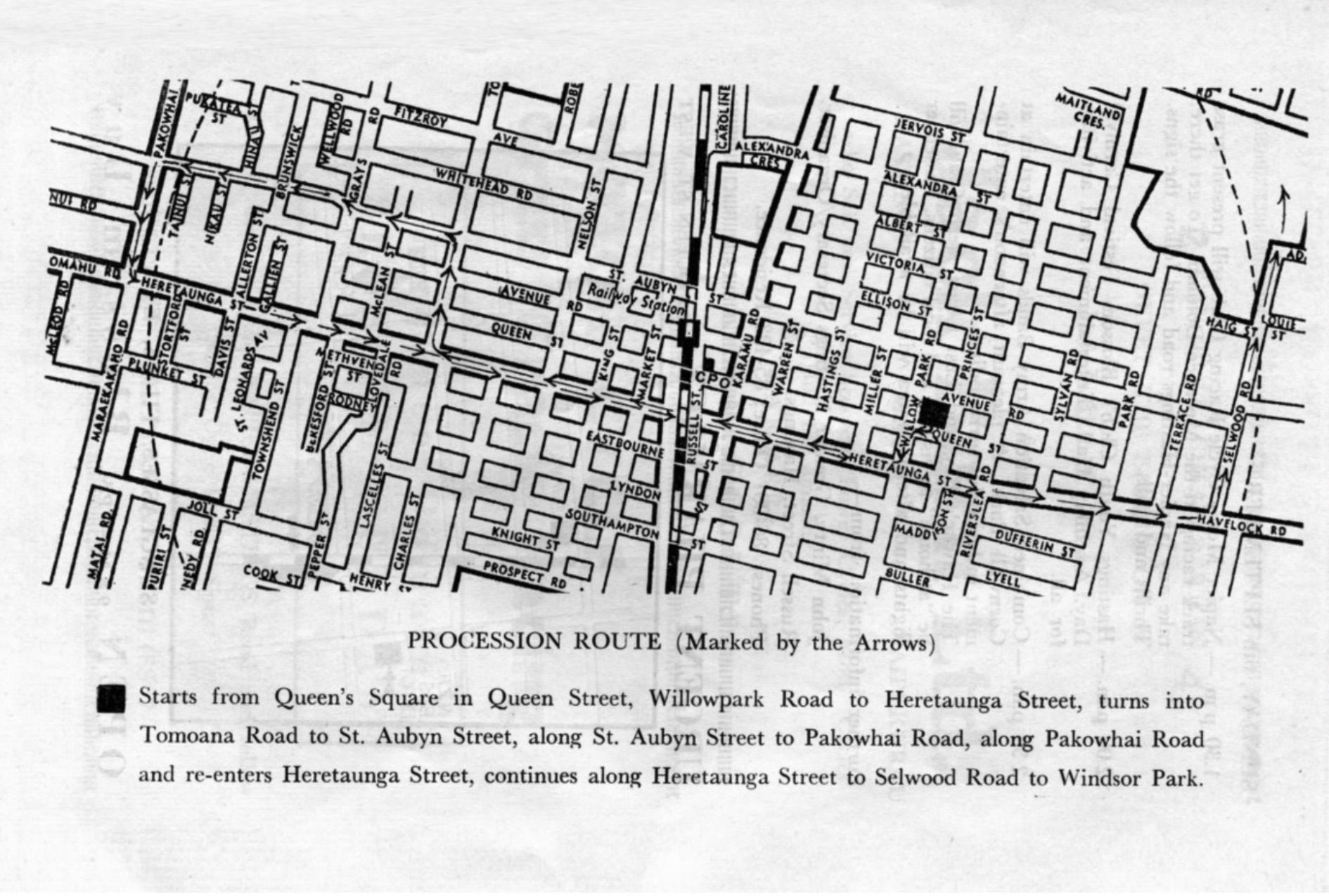 Blossom Festival 1964 · Procession route map from the official 1964 programme · Starts Queen's Square · via Willowpark Road · St Aubyn Street · Pakowhai Road · Heretaunga Street full length · Selwood Road · ends Windsor Park · Knowledge Bank accession 508360 · Hastings District Libraries · CC BY-NC-ND 4.0
The WestSide precinct sits in the middle of that route... Heretaunga Street West between the railway and Pakowhai Road was not the beginning or the end. It was the throughline. 50,000 people moved through this stretch because the route required it. Every business on the strip had a captive audience that filled the footpath and stood on the verandah rooflines for hours.
The street as event space. 50,000 people came to Heretaunga Street for the Blossom Festival in the 1950s. They did not come to a park. They did not come to an arena. They came to a street. The street itself was the venue. The businesses were open. The footpaths were the grandstands. The festival was proof that when this street is activated, it can hold an extraordinary number of people.
The next Blossom Festival is September 2026. The theme is Great Things Grow Here. The parade passes through Hastings. It always has.
Sources — Knowledge Bank / Hastings District Libraries · LindsayDA4641-1 Accession 797569 (1956) · ClappertonJ654-1 Accessions 654/755/34207 and 654/755/34204 (1958) · HillCA526-PomeroyF540 Accession 540/546/23101 (1958) · TobinJ662-7 Accession 807443 (1969) · Blossom Festival Programme 1964 Accession 508360 · All images CC BY-NC-ND 4.0 · Recollect Index Cards Library IDs 006724 and 007919 · Hastings District Libraries Recollect Collection · NZ Herald Historic HB series (HBToday) · Hastings District Council 150th Commemoration